Tuesday, 28 October 2014

A note on anti-capitalism

What is often referred to as the "anti-capitalist" movement is born from the accumulation of global discontents with various aspects of the neo-liberal project. The anti-capitalist movement is a radically plural movement made up of many denominations. It is multi-lingual, multi-cultural and multi-coloured, with multiple issues. The movement like the neo-liberal project is global in scope with the ability to turn out people anywhere in the world. The anti-capitalist movement has its roots in the global south in the mid 80’s where grassroots movements began to protest against IMF policies in what became known as the 'IMF riots' after the introduction of structural adjustment programmes and development practices in 1980. In 1985 landless workers movements in Brazil began to protest against the transferring of land from the farmers and indigenous people to multinational corporations. In 1988 Europeans entered the struggle when 80,000 people came from across Europe to protest at the IMF meetings in Berlin. In 1990 the first continental encounter of indigenous people was organised in Ecuador. Perhaps the most significant moment of the movement was on January 1st 1994 when the EZLN arose out of Chiapas, Mexico in opposition to the North American Free Trade Agreement (NAFTA) that would make Mexico into a free trade zone and an open market.

EZLN also referred to as the Zapatistas arose from among the indigenous peoples of Chiapas, Mexico who began to protest the destruction of their culture in the face of neo-liberalism. The Zapatistas appeared spouting poetry, Mayan culture and ideas of a new revolution. Hailed as post-modern revolutionaries the Zapatistas captured the imagination of the radical left and are seen by writers such as Naomi Klein as the leaders of the anti-capitalist movement. The Zapatistas are led by the charismatic Subcommandante Marcos, whose image is that of a masked, pipe smoking man, whose identity is hidden but is rumoured to be a Mestizo Marxist lecturer who left the city to organise the rural people of Mexico. The myth goes that when he arrived in Chiapas he attempted to convert the farmers to a standard Marxist theory regarding the workers but was met with blank stares, as the farmers began to express their philosophy of land and nature drawing upon their indigenous culture. Marcos became a student as well as a teacher and began working with the farmers to devise a new philosophy that incorporated Mayan teachings and radical left theory to create Zapatismo. The Zapatistas called upon all to become a Zapatista claiming that, 

‘Marcos is gay in San Francisco, black in South Africa, an Asian in Europe, a Chicano in San Ysidro, an anarchist in Spain, a Palestinian in Israel, a Mayan Indian in the streets of San Cristobal, a Jew in Germany, a Gypsy in Poland, a Mohawk in Quebec, a pacifist in Bosnia, a single woman on the Metro at 10 p.m., a peasant without land, a gang member in the slums, an unemployed worker, an unhappy student and, of course, a Zapatista in the mountains’. In other words, he is simply us: we are the leader we’ve been looking for." 

In 1998 fierce protests took place at the WTO meeting in Geneva at the UN building. In May of the same year 70,000 people joined together to encircle the G8 meetings in Birmingham, England. Protests also took place in 30 countries on 5 continents. In 1999 activists gathered in 43 countries at the time of the G8 summit in Koln and an insurrection took place in the financial sector of London. In November of the same year the most high profile event of the anti-capitalist movement took place on the streets of Seattle in protest to the WTO as thousands took part in battles against the police 20. 

In April 2000 US mobilisation was organised at the spring joint meetings of the IMF and World Bank in Washington DC. In September 2000 protestors mobilised at World Economic Forum meetings in Melbourne and at the Prague joint IMF and World Bank meetings. In August 2001 protestors from across the world hit the streets of Genoa to protest against the G8.   

The World Social Forum (WSF), the single most important institution of the movement, was launched in 2001 as a counter-part to the World Economic Forum meetings. WSF aims to bring together anti-capitalists in dialogue to discuss the possibilities of another world. The meetings have taken place all over the globe but have so far not been anything more than a space for deliberation. The WSF has not formulated any concrete political plans and has more emphasis on process than making progress.

The anti-capitalist movement has captured the world’s imagination through its spectacular acts of direct action. The movement has spawned hundreds of manifestos and beautifully poetic writings. It has lots of energy and they must be credited for identifying the enemy in neo-liberalism and recognizing the emergence of a new global order, however the movement has made no concrete political gains, there are no victories that the movement has under its belt. The anti-capitalist movement has proven itself to be nothing more than a series of global action days that some have referred to as ‘protest tourism’. The movement’s lack of a political institution that represents its interests in the democratic processes that exists or enables it to sit at the table to negotiate for their cause is a problem. Many of the loudest voices in the movement are the most avant-garde, the radical anarchists that totally reject any form of government, discipline or even democracy. As one grassroots movement has stated they “are not working for a place at the global table of negotiation".   

The movement’s lack of a coherent voice means that what the movement actually stands for is not clear to the public. There is not a constructive practice for people to be engaged in beyond attending planning meetings for global action days around massive issues that are disconnected from people’s everyday life. Participants cannot see the light at the end of the protest tunnel and become more disillusioned and cynical, as their demands are not met. Though the carnivalesque spectacle of the action days is amazing to witness it may not be the best tactic for recruiting new members, gaining public sympathy or ensuring that our demands are met.

The most well known slogan of the anti-capitalist movement is ‘another world is possible’, unfortunately the movement has not been able to define a viable alternative political vision beyond neo-liberalism. Neither has it been able to create a political practice beyond direct action. For the movement to become a counter-hegemonic project it must develop a new postmodern political praxis that goes beyond direct action and work to articulate a clearly defined global political vision.


This is what Russell Brand wants to talk about - The Rise of Neo-liberalism!

The rise of neo liberalism has been accompanied by the near total obliteration of the left. Since its adoption by the Chilean, US and UK government’s, neo-liberalism in some form has become the dominant mode of political thinking across the planet. 

The theory of Neo-liberalism has its origins in the writings and ideas of a energetic bunch of economists, philosophers and academics led by the Austrian political philosopher Friedrich Von Hayek and including notable economist Milton Friedman. The group took the name the Mont Pelerin Society in the late 1940's after the Swiss spa at which they regularly met. Those that gathered into the society styled themselves as radical liberals with the professed goal of defending human dignity and freedom. The ideas of the neo-liberals as they termed themselves also gained currency in the 50's at the University of Chicago where Friedman dominated the economics department. This led to neo-liberals being dubbed the Chicago school. The term neo-liberal was coined by the Mont Pelerin Society as a symbol of their commitment to the principles of the free market as defined by the economics of neo-classicism. The neo-liberals set themselves a theoretical mission of debunking ideas regarding state intervention and state planning as had been argued by Keynes. In the beginning neo-liberalism was a marginal philosophy that no one took seriously. After the war the dominant model of economics was the Keynesian model that placed emphasis on the state regulating and guiding the economy. Hayek, Friedman and the neo-liberals vehemently rejected the idea of state planning. Like Adam Smith they glorified the notion of the invisible hand as a regulator of human natures propensity for greed. Although the ideas of neo-liberalism began as obscure Hayek was committed to waging a war of ideas that would take a generation to reach the ears of those pulling the levers of power but would eventually displace the theories of Keynesians regarding state planning and intervention. In the 1970's neo-liberalism began to gain currency outside of the narrow academic circles that it had previously occupied. In 1974 Hayek was awarded the Nobel peace prize in economics followed by Friedman in 1976. This instigated a greater interest in the ideas of neo-liberalism by policy departments around the world. 

The University of Chicago had been training Chilean economists in the principles of neo-liberalism as a cold war tactic and in the late 70's after the military coup led by right wing dictator Augusto Pinochet the Chicago boys were called in to develop the economic policies of the Chilean government. More significantly in 1979 the UK government led by newly elected Prime Minister Margaret Thatcher adopted the ideas of Hayek. As David Harvey has written of Thatcher 'She recognised that this meant nothing short of a revolution in fiscal and social policies' and went ahead in deconstructing the social democratic policies that had dominated the UK politics since immediately after the war. Chinese premier Deng Xiaoping and Ronald Reagan in the US followed Thatcher in 1980.

In the early eighties the neo-liberal idea had become dominant in the US and formed the ideology of the 'Washington consensus', it began to dominate supra-national institutions like the International Monetary Fund, the World Bank and the World Trade Organisation. These supra-national organisations used their power to spread neo-liberalism further a field restructuring economies and creating free trade blocs. Neo-liberalism was thwarted in its quest for world domination during the eighties by the existence of the communist bloc in Eastern Europe. In the 1990's after the fall of the Berlin Wall and the collapse of communist economies neo-liberalism was given free reign all over the globe instigating the process now referred to as globalisation. The driving force behind the globalisation of neo-liberalism has been  supranational institutions such as the G8, World Trade Organisation, the IMF and the World Bank. These institutions have pushed neo-liberalism through loan conditions  forcing states to accept structural adjustment programme's through which their economies were restructured to fit the neo-liberal model. Limiting public services, opening up markets to foreign capital and commodities, relaxing labour laws and considerably undermining the national sovereignty of developing countries and increasing inequality.

The 2000’s saw neo-liberalism arrive as the single most dominant political ideology across the globe unchallenged by any other model of political economy. In the last 50 years we have observed neo-liberalism rise from obscurity to hegemony; from a set of theoretical ideas to a hegemonic political project. Bearing this in mind we must think of neo-liberalism as more than an economic theory but a hegemonic project that aims to 'change the soul' of humanity to serve the interests of those that make up the elite. Neo-liberalism is a set of ideas about what the human should be, how they should live and the values that should guide human life.

Unlike traditional liberal economics, that is an idea about the nature of the human, neo-liberalism aims to transform the human through the state. Their views on the human do not constitute a state of nature theory but a vision of what the human should be. Neo-liberalism holds that the most important human value is freedom. For neo-liberalism the culprit of evil is the state. The interference of the state in the affairs of the individual has led to an infringement of the rights of the individual, limiting the human’s ability to flourish. The central belief animating neo-liberalism is the belief in private property and the competitive market. For neo-liberals private property is a fundamental human right. State intervention in the market, they argue, is tainted by the political biases of powerful political bases and interest groups that lobby the state. State decisions on economic issues only lead to tyranny of the majority and inadequate economic decisions that can only be remedied by the signals produced in the market.

Neo-liberalism promotes the freeing of markets from state control and the opening of national markets to global capital and commodities. This includes the reduction of tariffs that protect the national sales of agricultural products. It argues in favour of the dismantling of the welfare state and social provision rejecting the notion of society in favour of the rational, acquisitive individual in pursuit of their self-interest. Private property and the privatisation of state owned utilities such as water, telecommunications and electricity are key policies in the neo-liberal project. It envisions all human activities as being able to fit into the model of the market. Public institutions such as universities and prisons, social welfare provisions like education and healthcare and even war are not seen as off limits from privatisation.  Seeds, genetic materials and cultural, historical forms can all be turned into the private property of individuals. The legal framework of neo-liberalism views the corporation as an individual so the freedom to acquire property is extended beyond the private property of a human entity to the legal entity of an incorporated company. Hence companies have the same rights as human beings to draw limitless natural, intellectual and human resources into their private ownership. In short neo-liberalism aims towards the commodification of everything including the building blocks of life itself. It aims to turn society into one big market made up of consumers free to choose what they buy or to expropriate the common wealth of humanity into their private possession.    

Neo-liberalism is a celebration of the individual over the community. The freedom of the individual to take part in free enterprise even at the expense of the communities and the social world that allows enterprise to flourish.

As David Harvey has pointed out neo-liberalism has constituted a redistribution of the wealth from the public to the rich. What we have witnessed with neo-liberalism is a reconstitution of class power. Although the power may not have been distributed to the old elites it has created a new elite made up of CEO's and high flying bankers. The privatisation of public resources has resulted in the expropriation of the common and institutions built on the taxpayer’s money into private hands.


Neo-liberalism has transferred power from the public realm to corporations, gigantic financial institutions and supra-national organisations seriously weakening the state and undermining democracy. In the neo-liberal utopia un-elected leaders committed to the financial bottom line run our democracies. Governments find themselves indebted to supra-national organisations and held to ransom by finance capital; political parties go in search of rich donors to fund campaigns and keep their parties afloat in exchange for political favours whilst voters drift away from the polls and civil society, and inequality grows.

A short history of community organising

Saul Alinsky coined the term ‘community organising’ in the 1940. Saul Alinsky was a Jewish American criminologist based in Chicago who after becoming disenchanted with social work in the 30's set about developing a method to mobilise low-income communities to build power in order to demand better wages and push corporations and the government to take more social responsibility. Alinsky began his quest by organising communities in Chicago, launching an organisation called 'Back of the yards'. During the 50's and 60's he worked with African American communities setting up the Wood Lawn organisation. Alinsky gained great notoriety as an agitator and communist- something that he denied.

Saul Alinsky established the (Industrial Areas Foundation (IAF) in 1940. The IAF was set up to train community organisers and develop affiliate organisations across the US and the world. IAF aimed to build organisations with the purpose of power and the product of social change. To date the IAF has 57 affiliate organisations across the US, in Germany and the UK. Although the organisation was founded by Saul Alinsky the modern methods of the IAF were developed by Ed Chambers an ex seminarian who had worked closely alongside Alinsky. Echo's of Alinsky ideas can still be heard in the teachings of the IAF but the raw organising antics of Alinsky have been quietly put to the background.

After Alinsky's death in the 1970's Chambers began to move the organisation towards a systematic training programme and the professionalisation of community organising and began shifting the focus towards congregation based organising. Chambers worked to develop Alinsky's method and formulated the model of organising that influenced Obama as a young community organiser in Chicago and is the model that IAF affiliate organizations and London Citizens work with.

London Citizens grew out of the Citizens Organisation Foundation (COF) that was set up by the organisations executive director and lead organiser Neil Jameson, and a collection of religious leaders in 1989 after Jameson travelled to the US to undertake training at the IAF. COF styling itself on the IAF attempted to build organisations in Yorkshire, Liverpool and Bradford but was unsuccessful eventually they struck gold with the formation of The East London Community Organisation (TELCO) in 1996. In London the COF started to put more emphasis on training organisers and leaders and began to hold regular training sessions; organisations were started in South and West London that together became the pan London organisation London Citizens. 

London Citizens is described as "a powerful grassroots charity working with local people for local people". It describes its goal as "social, economic and environmental justice" and claims to meet that need by "training people of all ages, faiths and backgrounds to take action together for change" 

In recent years COF, LC and TELCO have all been brought under one banner as Citizens UK. Citizens UK is described as "the biggest community alliance in Britain, bringing together more than 160 faith congregations, schools, universities, trade unions, and community groups with a quarter of a million citizens in our network. We work to end poverty, improve housing and make London safer".

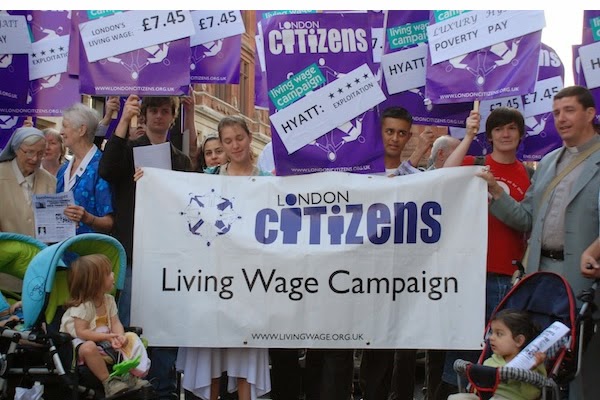
London Citizens has launched numerous campaigns across London; the biggest being the living wage campaign, a campaign to pressure employers to pay staff a living wage rather than the legal minimum wage, the argument being that the legal minimum wage does not secure workers a life above the income poverty line. The organisation worked with economists to find out how much it costs to secure a decent living in the city. In 2004 this was agreed at £7.05 and was adopted by the mayors office, which also set up a living wage unit to examine the issue, annually set the rate and encourage other employers to adopt the policy. London Citizens campaigned against HSBC one of the world's largest banks getting the executives at HSBC to raise the wages of its cleaning staff. London Citizens have also successfully lobbied the London School of Economics and Queen Mary University to implement the policy. The organisation has also launched campaigns for a community land trust, and campaigned for an amnesty for migrant workers amongst other things.


The model of organising utilised by Citizens UK offers an innovative method that can provide answers to re-organising and re-conceptualising the political practice of Progressive politics with a more effective political model. 

Friday, 24 October 2014

Thinking about a New Britannia

Yes Tony, what do you believe a 'new Britannia' entails and what should ultimately be the aim going forward?

Yes fam. That is a BIG question... I'm really thinking about it at the moment...  But, I would say that we cannot have a divided nation. We cannot let the old identity politics keep playing out where people align with "race" rather than Anglophone culture, nationhood and citizenship. there needs to be more internal branding to keep the nation together and politicians should try to take the lead by embracing a level of patriotism the way Obama is patriotic to the US. We cannot have people that are British citizens that hate the nation where they live so much. We need to have a talk about Empire and to heal the wounds of the past so we can move forward as One Britannia. We would need to make a concerted effort to make sure that Parliament and Government look more diverse. The many heritages make it easy for us to connect with the world. People of colour could be doing much more foreign diplomatic work with our roots. I think we need to have a one off amnesty for illegal immigrants and integrate them into the nation and then set limits on our borders and a more difficult criteria for entry. I think the philosophy of Britain needs to be explicit and known. Every child at school should read and understand John Stuart Mill's On Liberty as the basic philosophy of our nation and how it set's us apart from mono-cultural societies and why it is good. The history of the British Empire and how it led to modern Britain should be taught in all schools and the Empire without the Imperialism should form the basis of a multi-coloured Britain. So the story of Sikhs, Hindu's, Muslims, Africans, Caribbean's, Scots, Welsh, Irish and how they fought for Britain and contributed to it's development and were technically British as colonial subjects should be compulsory. Then New Britannia transcends "race", it is not a story of White Englishness but a colourful story that tells the truth about Britain's past and how it shaped it today. That is a bit of what i'm thinking...

London: Cannabis capital

The London Mayor should champion decriminalising Marijuana and an amnesty for all Londoners that hold a cannabis conviction. This would significantly reduce the amount of youth who have criminal records for marijuana possession and are excluded from unemployment because of past convictions. London would become the new Amsterdam with increased tourism in the city and an improved economy. Cannabis Cafe Licences should be made available from City Hall, the money generated could be used to tackle youth violence in the capital.

Friday, 17 October 2014

Community Organising: New politics for a New Britannia

I first came across community organising in 2004, after a friend introduced me to London Citizens and the Community Organising Foundation. After reading their literature I was impressed by their ideas and contacted the founder and lead organiser Neil Jameson. We arranged to meet the next day. On meeting we immediately sparked a political relationship and found points of commonality. By the next week I was on a 5-day residential training programme learning the fundamentals of community organising in Birmingham. On arrival at the training I was unaware of what to expect and was somewhat apprehensive, the other attendees were from very religious backgrounds some were nuns, there were Methodist sisters, Jesuit monks, Imams and veiled Islamic women but there were also some union workers form Community Union and some local community workers from Birmingham's Asian community. There were also some community organisers from the US, so it was quite a diverse group. The training included role-plays, a class based introduction to the principles of community organising, conversations and testimonials and in the evenings we would gather and discuss philosophy, religion and social issues. My initial apprehension began to wear of as I engaged with my fellow participants and I began to fall in love with community organising as a method of engagement. I was intrigued how they had been able to bring such a diverse group together and inspired by the common ground that we were able to find through dialogue and conversation. Previously my idea of politics had been tribal and rooted in the Black power movement, the experience allowed me to begin to view politics through new eyes. It was at this point that I began to think about how the method could be utilised to create a new politics for a New Britannia.

In the following months I took the time to read the writings of Saul Alinsky, who is known as the father of community organising, digesting his books Rules for Radicals and Reveille for Radicals. I began to operate out of South London Citizens (SLC) and over the next four years I spoke regularly at assemblies, represented London Citizens in the media, worked to strategically organise living wage campaigns and took part
in direct actions at the Tate Modern and Hilton hotel amongst others. I visited the US with London Citizens organisers to experience community organising in New York and see first hand the work of IAF organizations, visiting the East Brooklyn Congregations (EBC), the Nehemiah housing project- the flagship housing project of the IAF, and spent time reasoning with full-time organisers. I spent the summer of 2006 working as a community organiser, organising cleaners at the Tate Modern and Kensington hotel and became a trustee in the same year. I attended board meetings and a load of training sessions and worked on strategy with the leadership. This year London Citizens is coming to an end to become Citizens UK and all the former board members will be gathering to say goodbye and share old memories of the organisation. I am indebted to the organisation for some of my political thoughts. My experience working with a broad based community organisation has led me to believe that in the model of broad based community organisations lays the germ of a new politics for a New Britannia.

Saturday, 4 October 2014

A note on social roots

Someone said to me today that I am confusing because I am sometimes "middle class" and sometimes "underclass". My understanding is that it is about social roots. Where do you come from? What did you do and where did you go as a youth? What was the environment that you spent your youthful days in? For me I spent those days on council estates with what today would be called "hoodies". We used to smoke weed on the rooftops of Studley Estate, the blocks on Stockwell Park Estate or the corridors of Patmore Estate. We would go to parties on yellow brick estate in Peckham, Aylesbury in Camberwell and Angel Town in Brixton. We would walk in a gang of 20 man strong to go to Notting Hill Carnival; we would go on "steaming" sprees, all the "underclass" youth meeting at Lambeth Town Hall from every area to "steam" McDonalds, that is my roots. These are the spaces and experiences that grew me. If I was an African-American they would say I come from the hood! Your social roots are embedded in you, in the way you speak, the way you walk and your mannerisms. Jay-Z is a multi-millionaire and a grown man but he still raps about his experiences as a youth in Marcy projects, he never forgets it, it is in him... Yes, you can acquire some "middle class" intellect and study the great thinkers of the world but your social roots you carry with you for life, it is what has made you what you are. The question is, can someone with social roots in these spaces, in these experiences, in this culture make it in the political world? Can we tell that story? Is it allowed? Can I live?